Custom ovens, furnaces, retrofits and OEM support help manufacturers address demanding aerospace curing and heat-treatment requirements.
The aerospace industry places exceptionally high demands on industrial furnaces and ovens because even minor inconsistencies in curing or heat treatment can compromise safety, performance, certification, and overall component lifespan. Whether curing composite structures, heat treating metals, or processing coatings and adhesives, aerospace manufacturers must maintain extremely precise and repeatable thermal processing conditions.
One of the biggest challenges involves processing large and complex aerospace components. Wing structures, fuselage panels, engine components, composite layups, and honeycomb assemblies are often oversized or geometrically intricate, making it difficult to maintain consistent heating throughout the entire part. Manufacturers must evenly heat large thermal masses, maintain balanced airflow around irregular geometries, support parts without inducing stress, and avoid shadowing effects that can create temperature inconsistencies.
 These challenges matter because aerospace manufacturing operates under some of the strictest quality and compliance standards in the world. Many applications require compliance with AMS2750 pyrometry standards, NADCAP accreditation, and OEM-specific requirements from companies such as Boeing, Airbus, and Lockheed Martin. In many cases, temperature uniformity tolerances must remain within ±5°F — and sometimes even tighter for advanced composite materials.
Even small temperature variations can result in:
– Uneven curing
-Distortion or warping
-Weak bond lines
-Inconsistent metallurgical properties
– Reduced product reliability and performance
Modern aerospace manufacturing also relies heavily on advanced composite materials such as carbon fiber reinforced polymers. These materials require carefully controlled cure cycles involving ramp rates, dwell temperatures, vacuum pressure coordination, and moisture management. Improper curing conditions can lead to:
- Delamination
- Resin-rich or resin-starved areas
- Voids
- Poor adhesion
- Reduced mechanical strength
 Adding to the complexity, many aerospace systems integrate ovens, autoclaves, vacuum systems, multi-zone controls, and sophisticated data logging systems. Any synchronization failure between these systems can jeopardize expensive, high-value parts and delay production schedules.
At the same time, long cure cycles and heat treatment processes often create manufacturing bottlenecks. While manufacturers continually seek to improve throughput and reduce cycle times, doing so is not always straightforward. Faster temperature ramps may damage sensitive materials, shortcuts may violate specifications, and qualification testing for new processes can be both time-consuming and expensive.
Aerospace manufacturing is also highly regulated from a documentation and traceability standpoint. Manufacturers must ensure:
- Accurate data collection
- Secure data storage
- Audit readiness
- Operator accountability
For example, AMS2750 requires regular System Accuracy Tests (SATs), Temperature Uniformity Surveys (TUS), and instrument calibration schedules. Managing compliance across multiple ovens and furnaces can quickly become labor-intensive — especially for facilities still operating legacy thermal systems.
Many older thermal processing systems lack the automation, connectivity, and efficiency required for today’s aerospace manufacturing environment. Legacy systems often suffer from:
- Limited automation capabilities
- Poor data integration
- Reduced energy efficiency
- Obsolete controls
- Difficult spare parts sourcing
To remain competitive and meet evolving customer requirements, aerospace manufacturers increasingly need to adopt:
- Advanced controls and automation
- Improved airflow and thermal uniformity designs
- Industry 4.0 integration and process monitoring
- Energy-efficiency improvements
- Predictive maintenance capabilities
Long-term operational success of any oven or furnace is often best achieved through a strong partnership with the original equipment manufacturer (OEM). Working directly with the OEM for technical support, spare parts, audits, upgrades, and retrofits provides advantages that outside service organizations may struggle to consistently match.
 OEM support helps ensure:
- Replacement parts meet original design specifications
- Repairs and upgrades maintain approved system performance
- Equipment continues operating within required quality standards
- Compliance documentation remains accurate and supportable
Using non-OEM parts or unauthorized service providers can unintentionally alter system behavior, potentially increasing operational risk, downtime, validation requirements, and unexpected maintenance costs.
OEMs possess deep, system-level knowledge of how their equipment performs in real-world production environments. Their expertise provides:
- Insight into system interactions and performance limitations
- Access to proprietary engineering data and design updates
- Faster root-cause problem resolution
- Recommendations tailored to specific process requirements
Rather than applying temporary fixes, OEMs can help manufacturers optimize long-term system reliability, process consistency, and equipment lifespan.
Retrofit with Confidence Using OEM Solutions
As aerospace production requirements and regulations evolve, retrofits can help modernize existing equipment — but only when implemented correctly. OEM-supported retrofits help ensure upgrades:
- Integrate seamlessly with existing systems
- Align with original approvals and certifications
- Improve efficiency, safety, and performance
- Minimize operational risk and downtime
Third-party modifications may introduce unintended system changes that require additional validation, testing, or regulatory approval, potentially increasing both cost and complexity.
New equipment options:
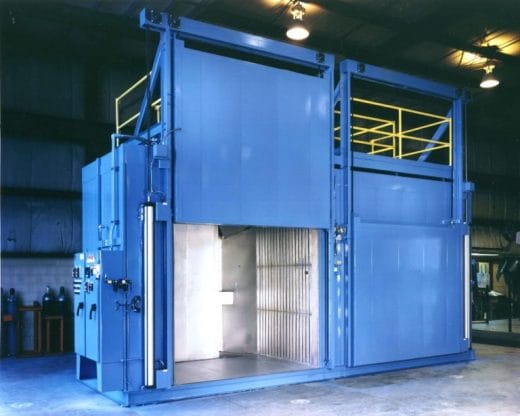 Recently, an aerospace manufacturer partnered with International Thermal Systems (ITS) to design and manufacture a custom batch oven tailored to its specific thermal processing requirements. ITS completed a rigorous final inspection and testing of a customized industrial oven tailored specifically for the aerospace sector. The meticulous review process, conducted by ITS’ expert engineers and technicians, involved thoroughly inspecting the oven’s operation, verifying custom specifications, and ensuring all tailored features performed flawlessly.
This intensive testing and fine-tuning process is an important part of ITS’ approach, helping ensure each system meets customer requirements and is ready for reliable operation from startup.
ITS’ detail-oriented methodology ensures that by investing significant time and expertise upfront, we minimize potential downtime and facilitate a seamless process. This approach allows our customers to achieve immediate productivity as soon as the equipment is operational onsite.
Choosing ITS means more than acquiring advanced equipment; it means forming a partnership with a dedicated team that is committed to your organization’s long-term success focused on your thermal processing needs. Each solution we provide is custom-designed and meticulously engineered to meet the unique operational needs of each customer, ensuring precision, efficiency, and customer satisfaction in every project we complete.
Enhance your thermal processing capabilities today by contacting ITS to learn how our team can develop a custom solution tailored specifically to your requirements.
Call 414-672-7700 or contact us via our website:
https://www.internationalthermalsystems.com/international-thermal-systems-contact